Electricity Rates in the US
Compare electricity rates and find a better electric rate based on data collected from 3530 electricity suppliers across the nation.
Electricity Statistics in USA
- Population 333,287,562
- Total Production 4,369,002,098 MWh / 13.11 MWh per capita
- Total Consumption 4,024,786,804 MWh / 12.08 MWh per capita
- Residential Consumption1,525,457,605 MWh
- Commercial Consumption1,455,255,318 MWh
- Industrial Consumption1,036,941,630 MWh
- Total Production from Renewable 996,774,866 MWh / 2.99 MWh per capita
- CO2 Emissions from Consumption 1,416,886,986,493 kg / 4,251.24 kg per capita
- Total Production from Non-Renewable 3,372,229,584 MWh / 10.12 MWh per capita
- Total Producing Power Plants11,921 plants
- Total Electricity Suppliers3,530 suppliers
- Electricity Generating Suppliers626 suppliers
- Total Electricity Customers165,753,936 accounts
- Residential Customers144,941,790 accounts
- Commercial Customers19,701,087 accounts
- Industrial Customers1,111,059 accounts
- Total Electricity Revenues530,128,268 thousands of $
- Residential Revenues253,603,652 thousands of $
- Commercial Revenues189,820,117 thousands of $
- Industrial Revenues85,788,619 thousands of $
Average Residential Electricity Bills & Rates in USA
USA residential electric rates are highest in March and the highest average bill is in July.
Historical Electricity Rates:
Here in the US, there are 165,753,936 electricity accounts being served by 3,530 electricity suppliers. There are 144,941,790 residential customers, which account for 37.9% of electricity sales; 19,701,087 commercial customers, which account for 36.16% of electricity sales, and 1,111,059 industrial customers, which account for 25.76% of electricity sales.
Electricity Provider Coverage in the USA
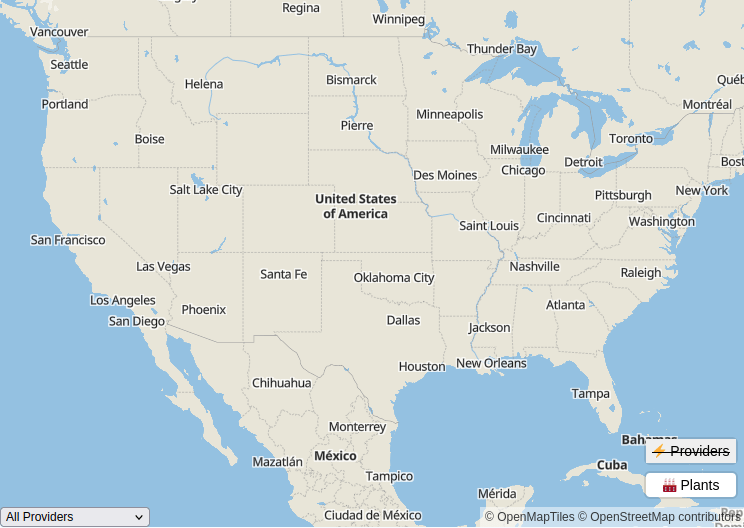
Above you can find a map of the coverage area of every electricity provider in the United States.
Mapping the coverage area of every electricity provider in the US is no easy feat. In fact, even government sources of utility coverage maps (such as the EIA and the Department of Homeland Security) are often highly flawed.
Our team has set out to have the most accurate coverage area data on the internet, and what you see in the map above is exactly that!
But we’re not settling. Our team is continuously improving our maps by confirming coverage areas with electricity providers and municipalities throughout the country. As utility lines change hands we will modify our data. We have also enabled anyone who wishes to embed our maps on their own website at the national, state, county, city or provider level.
For questions or more information about our coverage maps, contact us.
USA Production, Consumption, and Emissions by Fuel Types
The United States generates electricity from many different energy sources using many different energy technologies. Because electricity generation, transmission, distribution, and consumption have evolved so much in the last 100 years, energy sources and technologies have also changed, with some being used more than others.
Electricity is a secondary energy source that results from the conversion of primary sources of energy like coal, natural gas, oil, nuclear power, etc. While primary sources of electricity can either be nonrenewable such as fossil fuels and nuclear energy or renewable such as wind and solar, electricity itself is neither.
Electricity in the United States is mostly being generated at centralized utility-scale power plants. A small but growing fraction of the nation's electricity, however, is being generated using a variety of alternative renewable energy technologies such as small-scale solar photovoltaic systems.
In 2021, the United States generated 4,116 billion kWh of electricity. Roughly 61% was from fossil fuels, 19% was from nuclear energy, and 20% was from renewable energy sources.
Residential Electricity Providers in US
There are approximately 2,984 residential suppliers serving customers in the US. The average bundled residential electricity rate is 16.60 cents per kWh hour, but as our table shows below, prices can vary widely from provider to provider.
Of the 2,984 residential suppliers, only 626 of them generate any of their own electricity, while the rest purchase it through the wholesale market. As of March 2025, there were nationwide residential electricity sales totalling $64,482,798,203.
See more information about every residential electricity supplier below or on their dedicated data pages.
| Provider | HQ Location | Service Type | Residential Rate (¢) | Residential Rate National Rank | Residential Average Bill ($) | Residential Average Bill National Rank | Residential Sales (MWh) | Residential Sales National Rank | Residential Revenues ($) | Residential Revenues National Rank | Production (MWh) | Production National Rank |
|---|---|---|---|---|---|---|---|---|---|---|---|---|
| Duke Energy | Charlotte, North Carolina | BUNDLED | 14.87 | 1,866 | 149.63 | 880 | 78,486,808.59 | 1 | 11,559,200,535 | 1 | 227,722,099MWh | 2 |
| Florida Power & Light | Miami, Florida | BUNDLED | 13.66 | 1,393 | 157.74 | 700 | 67,068,153 | 2 | 9,107,414,560 | 3 | 146,516,722MWh | 6 |
| NextEra Energy | Houston, Texas | BUNDLED | 13.66 | 1,393 | 157.74 | 700 | 67,068,153 | 2 | 9,107,414,560 | 3 | 231,448,937MWh | 1 |
| Exelon Corporation | Chicago, Illinois | BUNDLED | 17.33 | 2,517 | 124.18 | 1,617 | 55,545,944.16 | 4 | 9,591,377,602.18 | 2 | 211,463,538MWh | 3 |
| First Energy | Akron, Ohio | BUNDLED | 16.25 | 2,260 | 139.23 | 1,140 | 48,005,204.12 | 5 | 7,799,012,138.67 | 5 | 45,383,668MWh | 22 |
| Southern Company | Atlanta, Georgia | BUNDLED | 16.08 | 2,216 | 173.54 | 431 | 46,327,274.98 | 6 | 7,496,897,014 | 6 | 182,179,081MWh | 4 |
| Dominion Energy | Richmond, Virginia | BUNDLED | 14.37 | 1,679 | 149.38 | 884 | 36,664,948.71 | 7 | 5,251,744,826 | 11 | 117,460,645MWh | 8 |
| Berkshire Hathaway Energy | Des Moines, Iowa | BUNDLED | 13.15 | 1,152 | 111.96 | 1,949 | 35,666,925.49 | 8 | 4,688,641,492.33 | 14 | 121,242,764MWh | 7 |
| American Electric Power | Columbus, Ohio | BUNDLED | 15.84 | 2,162 | 158.44 | 684 | 34,125,193.72 | 9 | 5,346,340,805 | 10 | 108,471,980MWh | 11 |
| NRG Energy | Houston, Texas | BUNDLED | 16.44 | 2,318 | 182.07 | 330 | 33,832,880.59 | 10 | 5,540,795,732.69 | 9 | 33,293,235MWh | 30 |
| Entergy Power | New Orleans, Louisiana | BUNDLED | 12.44 | 852 | 143.58 | 1,023 | 33,214,954.37 | 11 | 4,105,757,786 | 19 | 117,214,710MWh | 9 |
| Duke Energy Carolinas | Charlotte, North Carolina | BUNDLED | 14.09 | 1,562 | 140.35 | 1,110 | 27,769,285.46 | 12 | 3,854,324,059 | 20 | 84,935,474MWh | 13 |
| FirstEnergy Pennsylvania Electric Co | BUNDLED | 17.01 | 2,458 | 144.76 | 995 | 27,695,254.48 | 13 | 4,707,838,293.67 | 13 | 649 | ||
| Georgia Power | Atlanta, Georgia | BUNDLED | 15.69 | 2,122 | 162.8 | 608 | 27,399,621.5 | 14 | 4,361,074,590 | 16 | 66,611,883MWh | 16 |
| Vistra Energy | Irving, Texas | BUNDLED | 18.13 | 2,617 | 201.47 | 185 | 23,874,974.21 | 15 | 4,313,107,712.49 | 17 | 166,167,559MWh | 5 |
| Xcel Energy | Minneapolis, Minnesota | BUNDLED | 15.35 | 2,018 | 100.29 | 2,283 | 23,812,809.68 | 16 | 3,669,906,173 | 21 | 73,636,688MWh | 14 |
| PSEG | Newark, New Jersey | BUNDLED | 22.30 | 2,844 | 143.34 | 1,031 | 21,051,453.84 | 17 | 4,724,914,797 | 12 | 38,926,743MWh | 27 |
| Duke Energy Florida | Saint Petersburg, Florida | BUNDLED | 16.50 | 2,328 | 172.31 | 443 | 20,755,027.74 | 18 | 3,406,008,333 | 22 | 44,032,427MWh | 25 |
| Commonwealth Edison | Chicago, Illinois | BUNDLED | 15.43 | 2,043 | 91.17 | 2,522 | 19,082,732.24 | 19 | 2,929,877,372 | 28 | 649 | |
| NV Energy | Las Vegas, Nevada | BUNDLED | 13.59 | 1,354 | 118.46 | 1,757 | 18,877,951.57 | 20 | 2,560,524,795.33 | 33 | 66,238,596MWh | 17 |
Commercial Electricity Providers in US
Approximately 3,048 electricity suppliers provide service to commercial accounts throughout the US. Bundled commercial electricity rates range from 0.18 to 130.76 cents per kWh, but the current average rate over the last year is 13.00 cents.
While different business types will have widely varying monthly electricity bills, the average monthly commercial electricity bill in the US is $805.89
See more information about every commercial electricity supplier below or on their dedicated data pages.
| Provider | HQ Location | Service Type | Commercial Rate (¢) | Commercial Rate National Rank | Commercial Average Bill ($) | Commercial Average Bill National Rank | Commercial Sales (MWh) | Commercial Sales National Rank | Commercial Revenues ($) | Commercial Revenues National Rank | Production (MWh) | Production National Rank |
|---|---|---|---|---|---|---|---|---|---|---|---|---|
| Duke Energy | Charlotte, North Carolina | BUNDLED | 10.77 | 835 | 643.79 | 780 | 67,493,780.86 | 1 | 7,258,882,760 | 1 | 227,722,099MWh | 2 |
| Dominion Energy | Richmond, Virginia | BUNDLED | 9.27 | 394 | 1,271.79 | 240 | 60,328,837.93 | 2 | 5,588,502,275 | 5 | 117,460,645MWh | 9 |
| NextEra Energy | Houston, Texas | BUNDLED | 10.56 | 743 | 739.39 | 592 | 50,623,974.49 | 3 | 5,320,968,909.27 | 6 | 231,448,937MWh | 1 |
| Florida Power & Light | Miami, Florida | BUNDLED | 10.65 | 787 | 737.48 | 594 | 50,092,733.74 | 4 | 5,307,153,270 | 7 | 146,516,722MWh | 6 |
| Southern Company | Atlanta, Georgia | BUNDLED | 12.60 | 1,589 | 929.49 | 367 | 47,168,134.09 | 5 | 5,962,400,309 | 4 | 182,179,081MWh | 4 |
| Berkshire Hathaway Energy | Des Moines, Iowa | BUNDLED | 9.65 | 475 | 566.46 | 972 | 33,827,056.84 | 6 | 3,269,439,993.89 | 10 | 121,242,764MWh | 8 |
| Xcel Energy | Minneapolis, Minnesota | BUNDLED | 11.59 | 1,208 | 663.2 | 731 | 32,970,766.33 | 7 | 3,831,594,391 | 8 | 73,636,688MWh | 15 |
| Georgia Power | Atlanta, Georgia | BUNDLED | 11.81 | 1,286 | 1,014.27 | 315 | 31,965,811.14 | 8 | 3,796,822,545 | 9 | 66,611,883MWh | 17 |
| Duke Energy Carolinas | Charlotte, North Carolina | BUNDLED | 9.97 | 552 | 622.65 | 841 | 28,427,694.14 | 9 | 2,829,851,212 | 16 | 84,935,474MWh | 14 |
| Entergy Power | New Orleans, Louisiana | BUNDLED | 10.43 | 694 | 689.29 | 672 | 28,392,381.72 | 10 | 2,948,506,687 | 15 | 117,214,710MWh | 10 |
| Exelon Corporation | Chicago, Illinois | BUNDLED | 11.93 | 1,334 | 479.2 | 1,307 | 26,788,123.23 | 11 | 3,201,357,393.2 | 11 | 211,463,538MWh | 3 |
| Southern California Edison | Rosemead, California | BUNDLED | 22.01 | 2,903 | 1,206.71 | 254 | 26,721,861 | 12 | 5,978,179,000 | 2 | 10,681,587MWh | 86 |
| Edison International | Rosemead, California | BUNDLED | 22.01 | 2,903 | 1,206.71 | 254 | 26,721,861 | 12 | 5,978,179,000 | 2 | 10,681,587MWh | 86 |
| American Electric Power | Columbus, Ohio | BUNDLED | 11.46 | 1,128 | 582.15 | 935 | 26,687,815.25 | 14 | 3,051,666,759.33 | 13 | 108,471,980MWh | 12 |
| NRG Energy | Houston, Texas | BUNDLED | 10.11 | 599 | 624.19 | 836 | 20,104,005.94 | 15 | 2,035,996,244.58 | 20 | 33,293,235MWh | 32 |
| PacifiCorp | Portland, Oregon | BUNDLED | 9.49 | 441 | 740.36 | 589 | 20,093,140.26 | 16 | 1,907,811,135 | 24 | 45,155,533MWh | 24 |
| PSEG | Newark, New Jersey | BUNDLED | 17.97 | 2,709 | 702.58 | 646 | 17,236,121.68 | 17 | 3,119,604,261 | 12 | 38,926,743MWh | 29 |
| Evergy | Kansas City, Missouri | BUNDLED | 10.57 | 748 | 816.35 | 483 | 16,966,286.77 | 18 | 1,805,693,940 | 27 | 33,028,115MWh | 34 |
| Northern States Power Company | Minneapolis, Minnesota | BUNDLED | 12.48 | 1,553 | 828.98 | 467 | 15,664,183.49 | 19 | 1,959,771,120 | 22 | 35,568,612MWh | 30 |
| DTE Energy | Cincinnati, Ohio | BUNDLED | 14.10 | 2,117 | 921.95 | 373 | 15,155,716.02 | 20 | 2,136,819,500 | 19 | 43,523,658MWh | 27 |
Industrial Electricity Providers in US
According to our data, approximately 2215 electricity providers offer industrial electricity service throughout the US.
Industrial accounts usually are offered significantly lower rates due to the amount of electricity that they use. Over the last 12 months the average bundled rate per kWh for industrial electricity in the US is 8.30 cents.
See more information about every industrial electricity supplier below or on their dedicated data pages.
| Provider | HQ Location | Service Type | Industrial Rate (¢) | Industrial Rate National Rank | Industrial Average Bill ($) | Industrial Average Bill National Rank | Industrial Sales (MWh) | Industrial Sales National Rank | Industrial Revenues National Rank | Production (MWh) | Production National Rank |
|---|---|---|---|---|---|---|---|---|---|---|---|
| Entergy Power | New Orleans, Louisiana | BUNDLED | 5.56 | 134 | 5,944.57 | 1,398 | 53,129,068.02 | 1 | 4 | 117,214,710MWh | 10 |
| Southern Company | Atlanta, Georgia | BUNDLED | 7.62 | 633 | 18,325.72 | 984 | 45,085,781.66 | 2 | 1 | 182,179,081MWh | 4 |
| Berkshire Hathaway Energy | Des Moines, Iowa | BUNDLED | 7.36 | 559 | 7,721.45 | 1,298 | 43,062,805.21 | 3 | 2 | 121,242,764MWh | 8 |
| Duke Energy | Charlotte, North Carolina | BUNDLED | 7.76 | 678 | 19,959.67 | 953 | 39,734,728 | 4 | 3 | 227,722,099MWh | 2 |
| Vistra Energy | Irving, Texas | BUNDLED | 6.69 | 357 | 838.33 | 1,976 | 38,745,155.58 | 5 | 5 | 166,167,559MWh | 5 |
| TXU Energy | Irving, Texas | BUNDLED | 6.69 | 357 | 838.33 | 1,976 | 38,745,155.58 | 5 | 6 | 563 | |
| Entergy Louisiana | West Monroe, Louisiana | BUNDLED | 5.09 | 89 | 14,628.65 | 1,067 | 32,438,840.02 | 7 | 11 | 50,044,804MWh | 22 |
| American Electric Power | Columbus, Ohio | BUNDLED | 8.00 | 782 | 8,867.62 | 1,245 | 31,158,070.19 | 8 | 7 | 108,471,980MWh | 12 |
| Xcel Energy | Minneapolis, Minnesota | BUNDLED | 6.75 | 371 | 135,734.4 | 209 | 28,770,152.45 | 9 | 9 | 73,636,688MWh | 15 |
| NV Energy | Las Vegas, Nevada | BUNDLED | 7.16 | 486 | 35,342.94 | 729 | 25,874,397.07 | 10 | 10 | 66,238,596MWh | 18 |
| NRG Energy | Houston, Texas | BUNDLED | 6.67 | 353 | 23,293.21 | 882 | 21,911,940.46 | 11 | 14 | 33,293,235MWh | 31 |
| Georgia Power | Atlanta, Georgia | BUNDLED | 7.33 | 542 | 13,817.91 | 1,084 | 21,811,458.15 | 12 | 12 | 66,611,883MWh | 17 |
| Reliant Energy | Houston, Texas | BUNDLED | 6.66 | 351 | 64,658.33 | 487 | 21,727,769.98 | 13 | 15 | 563 | |
| Alabama Power | Birmingham, Alabama | BUNDLED | 8.09 | 813 | 22,761.96 | 896 | 18,895,019 | 14 | 13 | 61,057,591MWh | 20 |
| Tennessee Valley Authority | Knoxville, Tennessee | BUNDLED | 4.57 | 64 | 1,687,569.21 | 12 | 18,814,266.59 | 15 | 22 | 134,771,158MWh | 7 |
| Duke Energy Carolinas | Charlotte, North Carolina | BUNDLED | 7.52 | 602 | 21,110.02 | 927 | 18,313,003.3 | 16 | 16 | 84,935,474MWh | 14 |
| PacifiCorp | Portland, Oregon | BUNDLED | 7.70 | 660 | 3,680.52 | 1,589 | 17,188,408.14 | 17 | 17 | 45,155,533MWh | 24 |
| MidAmerican Energy | Des Moines, Iowa | BUNDLED | 6.04 | 218 | 55,843.91 | 545 | 17,159,219.02 | 18 | 19 | 45,044,932MWh | 25 |
| Rocky Mountain Power | Portland, Oregon | BUNDLED | 7.35 | 550 | 5,986.2 | 1,395 | 14,700,700.79 | 19 | 18 | 563 | |
| Southwestern Public Service Company | Amarillo, Texas | BUNDLED | 4.69 | 67 | 177,769.28 | 157 | 14,348,060.07 | 20 | 28 | 15,007,063MWh | 66 |
Power Plants in USA
| Plant | City/County | State | Primary Fuel Type | Production (MWh) | Production National Rank | Emission (KG) | Emission National Rank | Emissions/MWh (KG/MWh) | Emissions/MWh National Rank | Toxic Chemical Release | Closing Date |
|---|---|---|---|---|---|---|---|---|---|---|---|
| Burke County | GA | Nuclear | 35,585,243 | 1 | 4 | 4 | |||||
| Maricopa County | AZ | Nuclear | 32,338,745 | 2 | 4 | 4 | |||||
Browns FerryTennessee Valley Authority (100.00%) | Limestone County | AL | Nuclear | 29,306,275 | 3 | 4 | 4 | ||||
| York County | PA | Nuclear | 21,882,723 | 4 | 4 | 4 | |||||
| Oconee County | SC | Nuclear | 21,610,908 | 5 | 4 | 4 | |||||
Turkey PointFlorida Power & Light (100.00%) | Miami-Dade County | FL | Nuclear | 21,433,041.01 | 6 | 2,625,340,386.04 | 1 | 122.49 | 1 | ||
| Mecklenburg County | NC | Nuclear | 19,970,828 | 7 | 4 | 4 | |||||
| Luzerne County | PA | Nuclear | 19,787,561 | 8 | 4 | 4 | |||||
Byron Generating StationExelon Corporation (100.00%) | Ogle County | IL | Nuclear | 19,786,235 | 9 | 4 | 4 | ||||
West County Energy CenterFlorida Power & Light (100.00%) | Palm Beach County | FL | Natural Gas | 19,574,000.05 | 1 | 7,345,148,104.28 | 2 | 375.25 | 1,420 | ||
LimerickExelon Corporation (100.00%) | Montgomery County | PA | Nuclear | 19,451,866 | 10 | 4 | 4 | ||||
Comanche PeakLuminant Energy (100.00%) | Somervell County | TX | Nuclear | 19,443,582 | 11 | 4 | 4 | ||||
Braidwood Generation StationExelon Corporation (100.00%) | Will County | IL | Nuclear | 19,414,757 | 12 | 4 | 4 | ||||
LaSalle Generating StationExelon Corporation (100.00%) | LaSalle County | IL | Nuclear | 19,302,485 | 13 | 4 | 4 | ||||
| Matagorda County | TX | Nuclear | 19,235,936 | 14 | 4 | 4 | |||||
| Jefferson County | AL | Coal | 18,933,591.11 | 1 | 18,595,888,654.19 | 1 | 982.16 | 140 | |||
| Salem County | NJ | Nuclear | 18,603,560 | 15 | 4 | 4 | |||||
Diablo CanyonPacific Gas and Electric Company (100.00%) | San Luis Obispo County | CA | Nuclear | 18,336,388 | 16 | 4 | 4 | ||||
| York County | SC | Nuclear | 18,322,501 | 17 | 4 | 4 | |||||
Donald C CookIndiana Michigan Power (100.00%) | Berrien County | MI | Nuclear | 18,002,629 | 18 | 4 | 4 |
The United States electricity system consists of a complex network of interconnected power plants and decentralized units, substations, transformers, transmission and distribution wires, and electricity end-users. This complex network is often referred to as the US power grid.
According to the U.S. Energy Information Administration, the United States power grid connects approximately 165,753,936 electricity consumers nationwide. Infastructure-wise, the US grid consists of roughly 11,921 power plants, 160,000 miles of high-voltage power lines, and 5.5 million miles of low-voltage power lines.
It is important that electric utility companies and grid operators are able to work seamlessly in order to generate the right amount of electricity to meet demand. Since it is near-impossible to store excessively large amounts of electricity, electricity must be generated as it is consumed. The total amount of electricity that must be generated largely depends not only on the individual consumption of homes and businesses, but on other factors as well, such as the time of day and weather, among many others.
When there's a dramatic increase in electricity demand, the grid responds in a number of ways. The grid either increases production from operational power plants, or it activates power plants that are on standby, or it imports electricity from outside sources, or at times, it even calls on end-users to consume less electricity.
Provider Data by State
Electricity rates and average bills vary widely from state to state. Below you can compare all 50 states and Washington DC on a variety of metrics.
| State | Population | Providers | Plants | Residential Rate (¢) | Residential Avg. Electric Bill | Commercial Rate (¢) | Commercial Avg. Electric Bill |
|---|---|---|---|---|---|---|---|
| Alabama | 5,074,296 | 66 | 91 | 15.77 | $180.35/mo | 14.10 | $707.31/mo |
| Alaska | 733,583 | 105 | 156 | 24.28 | $143.78/mo | 22.02 | $816.16/mo |
| Arizona | 7,359,197 | 76 | 204 | 15.44 | $154.78/mo | 12.89 | $1033.28/mo |
| Arkansas | 3,045,637 | 45 | 115 | 12.34 | $129.24/mo | 10.11 | $486.62/mo |
| California | 39,029,342 | 207 | 2156 | 31.00 | $162.95/mo | 23.93 | $1203.60/mo |
| Colorado | 5,839,926 | 93 | 326 | 15.16 | $100.46/mo | 11.86 | $532.70/mo |
| Connecticut | 3,626,205 | 107 | 201 | 29.58 | $187.30/mo | 21.61 | $574.38/mo |
| Delaware | 1,018,396 | 104 | 39 | 16.53 | $151.73/mo | 15.51 | $437.70/mo |
| District of Columbia | 671,803 | 95 | 21 | 16.77 | $101.16/mo | 19.61 | $1064.01/mo |
| Florida | 22,244,823 | 67 | 386 | 14.25 | $158.15/mo | 11.04 | $716.56/mo |
| Georgia | 10,912,876 | 102 | 296 | 14.70 | $155.02/mo | 11.40 | $864.87/mo |
| Hawaii | 1,440,196 | 19 | 92 | 43.11 | $205.29/mo | 39.42 | $1338.16/mo |
| Idaho | 1,939,033 | 38 | 170 | 11.62 | $108.78/mo | 9.27 | $430.58/mo |
| Illinois | 12,582,032 | 219 | 492 | 15.18 | $100.88/mo | 12.47 | $367.17/mo |
| Indiana | 6,833,037 | 127 | 266 | 14.89 | $135.28/mo | 12.66 | $660.28/mo |
| Iowa | 3,200,517 | 189 | 335 | 13.02 | $106.14/mo | 10.14 | $413.13/mo |
| Kansas | 2,937,150 | 157 | 188 | 14.31 | $124.27/mo | 11.29 | $604.48/mo |
| Kentucky | 4,512,310 | 67 | 80 | 12.84 | $137.12/mo | 11.59 | $624.57/mo |
| Louisiana | 4,590,241 | 43 | 122 | 11.64 | $140.34/mo | 10.37 | $718.91/mo |
| Maine | 1,385,340 | 72 | 256 | 23.31 | $127.75/mo | 20.32 | $342.17/mo |
Environmental Impacts of Electricity
Electricity in itself is a clean and relatively safe form of energy. Its cultivation for human use makes most modern conveniences possible. The generation, transmission, and distribution of electricity, however, tends to affect the environment.
Nearly all types of electricity generation have an effect on our air, water and land. The extent to which these impact the environment, however, varies and largely depends on how the electricity is generated.
Electricity generated from renewable energy sources is generally less harmful to the environment than electricity generated from fossil-fuel sources. For example, coal is a much more environmentally harmful energy source than solar power, which carries significantly less environmental dangers since no fuels are combusted. This is why there is a concerted global effort to move away from fossil fuels to renewable sources of energy.
Electricity companies use different sources, processes, and technologies to generate electricity. Outside of meeting electricity demands, US electric companies are tasked to use fuel more efficiently in order to minimize the emission of greenhouse gasses and other air pollutants.
The United States, predominantly through the US Environmental Protection Agency (EPA), enforces laws that regulate the effects of electricity generation and transmission on the environment. The EPA administers the Clean Air Act in order to regulate and reduce major air pollutant emissions from power plants.
USA Production Fuel Makeup


Basic Physics of Electricity
Despite its unquestionable significance in our day-to-day lives, we don’t often think about what electricity is exactly and how it manages to power our homes and establishments.
Electricity consists of atoms, much like everything else. This means that a basic understanding of electricity demands a basic understanding of atoms.
As you know, the human eye is far from capable of seeing atoms; if it is, however, an atom would resemble a cluster of balls surrounded by bubbles, which are technically referred to as shells. On the surface of these bubbles, you can find constantly spinning electrons. Electrons tend to move as far away from each other as possible. At the heart of an atom is the nucleus; the nucleus itself consists of particles called protons and neutrons.
Electrons carry negative charge, protons carry a positive charge, and neutrons carry no charge whatsoever. Being that they carry opposite charges, electrons and protons naturally tend to attract each other.
The electrons that spin closest to the nucleus tend to have a stronger attraction to the protons than the electrons that are further away from the nucleus. The electrons that have the least attraction to the protons tend to be knocked out of their orbits; when this happens, the electrons shift from one atom to another. These shifting electrons are electricity.
History of Electricity
Electricity is an inseparable part of modern life. Electricity has become so vital that it’s very difficult to imagine everyday life without it. Amazingly though, electricity has only been a part of the world for a little over a century.
Before the advent of electricity, about 100 years ago—it was candles and kerosene lamps that provided light, it was ice boxes that kept food cold, and it was wood-burning and coal-burning stoves that cooked food.
A long list of scientists and inventors worked tirelessly to unravel the principles of electricity since the 1600s. It was, however, Benjamin Franklin, Thomas Edison, and Nikola Tesla who made the most significant contributions to bringing electricity into homes to power indoor lighting and into factories to power industrial machines.
In 1752, Benjamin Franklin, through his now legendary kite experiment, demonstrated that lightning was electricity. In the late 1800s, Thomas Edison invented what would ultimately become the predecessor to the modern light bulb. Also in the late 1800s, Nikola Tesla first laid out the foundations of alternative current generation and transmission.
In the infancy of the US electric system roughly 120 years ago, electricity was generated through isolated plants that served individual customers. In the course of the next 50 years, utilities began linking these isolated generating plants, forming electric systems.
By the mid-1930's, it became apparent that interconnected electric systems made for a more reliable method of generating and transmitting electricity. Interconnected electric systems made back-up generation possible in the event of equipment failure, routine maintenance, or high energy demand. Additionally, interconnected electric systems also made practical economic sense as it made the sharing of energy resources and energy reserves a possibility.
In the 1960's, the transformation of the modern-day electric system from isolated generators to an interregional grid was completed. More about the electric grid later.
War of the Currents: AC vs DC
During the late 1880s, three legendary inventors, Thomas Edison, Nikola Tesla and George Westinghouse were embroiled in a battle that would shape the future of electricity as we know it today. Dubbed as the “War of the Currents”, the three were caught in a bitter dispute on whether electricity should be transmitted direct current (DC) or as alternating current (AC).
Thomas Edison developed direct current. DC is an electrical current that runs steadily in a single direction, like in a battery or a fuel cell. DC was the standard in the early years of electricity in the US. However, DC was a little problematic in that it cannot reliably be converted to higher or lower voltages.
Nikola Tesla and George Westinghouse championed the alternating-current system, claiming that it was the solution to the DC’s conversion problem. AC is an electrical current that reverses direction 60 times per second, making it possible to be converted to higher or lower voltages through the use of a transformer. Consequently, AC made it possible for electricity to be transmitted over long distances at lower losses.
Today electricity in the United States is still predominantly powered by AC. However, since DC is far more stable, consumer appliances, household electronics, computers, mobile devices, solar cells and electric vehicles all run on DC power.
Electricity Regulation
The United States sets and enacts policies on electricity generation, transmission, distribution, and consumption through various executive and legislative bodies of the federal government and state governments. Electricity regulation is generally based on two main categories:
- Wholesale sales and transmission of electricity in interstate commerce
- Local distribution and sales of electricity at retail
On a federal level, the Department of Energy oversees national energy policies, the Federal Energy Regulatory Commission regulates interstate power sales and service, the Environmental Protection Agency sets environmental protection policies, and the Federal Trade Commission enacts consumer protection and the prevention of anti-competitive practices.
On a state level, state governments—through their Public Utilities Commissions, Public Services Commissions, or equivalent offices—regulate the rates for electricity distribution and retail electric service and oversee policies on the planning and siting of electric facilities.
In many instances, there exist multiple overlaps of responsibilities and jurisdictions between these federal and regulatory offices. These overlaps often result in a complex web of legal, regulatory, and technical considerations for manufacturers, sellers, consumers of electricity.
Electricity Deregulation
The retail electricity market is mainly determined at the state level. It generally falls under two main categories—traditionally regulated markets and deregulated energy markets.
In a traditionally regulated market, consumers of electricity don’t have a choice on where to purchase their energy from other than their local utility companies, typically at prices set by the government.
In comparison, residential, commercial, and industrial consumers in a deregulated electricity market can shop around for the energy plan that best meets their energy requirements and they can purchase this plan from the energy provider of their own choosing.
The deregulated market empowers consumers to shop for rates, services and contract terms that best fit their needs. Additionally, one of the biggest selling points of a deregulated energy market is that it gives the consumers the option to switch to a better energy provider, especially if they’re not satisfied with their current one.
In many instances, energy deregulation is the state's way to restructure the existing energy market in a way that will increase competition among energy providers and ultimately prevent energy monopolies.The government does this by reforming old laws and creating new laws altogether that allow multiple suppliers to compete on the market.
Competition is vital to a healthy electricity market as it naturally encourages electricity providers to offer better plans and terms, lower rates and prices, and more compelling end-user experience in order to attract and retain consumers.
It’s worth noting that although energy users can choose where to purchase their energy from, utility companies still own and control the delivery infrastructure.
Electricity Rates by State
- Alabama
- Alaska
- Arizona
- Arkansas
- California
- Colorado
- Connecticut
- Delaware
- District of Columbia
- Florida
- Georgia
- Hawaii
- Idaho
- Illinois
- Indiana
- Iowa
- Kansas
- Kentucky
- Louisiana
- Maine
- Maryland
- Massachusetts
- Michigan
- Minnesota
- Mississippi
- Missouri
- Montana
- Nebraska
- Nevada
- New Hampshire
- New Jersey
- New Mexico
- New York
- North Carolina
- North Dakota
- Ohio
- Oklahoma
- Oregon
- Pennsylvania
- Puerto Rico
- Rhode Island
- South Carolina
- South Dakota
- Tennessee
- Texas
- Utah
- Vermont
- Virginia
- Washington
- West Virginia
- Wisconsin
- Wyoming
FAQ: Common Questions About Energy in the USA
Which electricity company is the largest supplier in the US?
Exelon Corporation is the largest electricity company in the US by total revenue and total customer count.
What is the average electric bill in the US?
In 2025, the US has an average electric bill of $146.54.
Where does the United States get its electricity?
The US' electricity is generated using mainly nuclear, which makes up 17.88% of the fuel used in the state. In addition, coal makes up 15.84% and wind accounts for 10.65%.
What is a good electricity rate in the US?
A good electricity rate in the US would be somewhere below the national average of 16.60 cents per kilowatt hour. Anything below that amount would be better than most other rates in the nation. Currently, the varying rates in the US range from 3.34 cents per kilowatt hour up to 152.92 cents per kilowatt hour.
How many power plants are located in the US?
There are 11,921 active electricity plants located in the US.
How many electric companies offer service in the US?
There are 3,530 electricity suppliers serving customers in the US.
What is the cheapest electricity company in the US?
| Lowest Rate Rank | Provider | Residential Rate (¢) | Est. Residential Customers |
|---|---|---|---|
| 1 | Douglas County PUD | 3.34 | 16,953.1 |
| 2 | Rouses Power | 3.58 | 1,123.6 |
| 3 | Watkins Electric | 3.72 | 996.2 |
| 4 | Chelan County PUD | 3.83 | 42,679.7 |
| 5 | Skaneateles, New York Electric Utility | 4.17 | 1,228.4 |
| 6 | Hildreth, Nebraska Electric Utility | 4.29 | 257 |
| 7 | Wellsville Power | 4.37 | 1,786.1 |
| 8 | Penn Yan, New York Electric Utility | 4.56 | 2,576 |
| 9 | Andover, New York Electric Utility | 4.73 | 569.8 |
| 10 | Spencerport Electric | 4.77 | 2,413.6 |